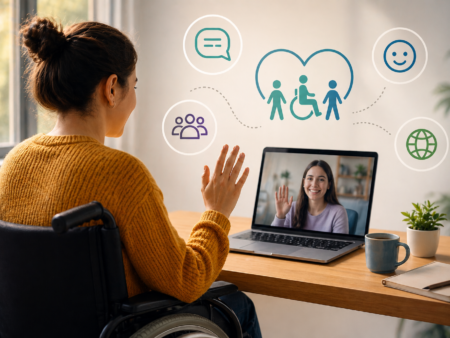
How the Internet Reduces Social Isolation and Rebuilds Real Human Connections
when the real world becomes harder to access, the digital world becomes a bridge
For many people with disabilities, social life is not a simple choice. Sometimes, the issue is not the lack of desire to interact, but the lack of real opportunities: limited accessibility, transportation challenges, social barriers, or simply physical and emotional exhaustion.
And this is where something interesting happens: the internet does not “replace” the real world — it extends it.
Online communication has become a space where distance disappears, time is no longer a barrier, and where, for the first time, many people can socialize without the stress of face-to-face interactions.
Why social isolation is a real mental health issue
Social isolation is not just a feeling of loneliness. In psychology, it is strongly associated with:
- depression
- anxiety
- low self-esteem
- lack of motivation
- gradual withdrawal from social life
Social psychology research shows that humans need regular social connections for emotional stability. It is not just the number of relationships that matters, but the quality of interactions and the sense of belonging.
How online communication changes the rules completely
🔓 1. It removes physical barriers
The internet allows:
- communication without travel
- equal access regardless of mobility
- social interaction from any location
For a person with a disability, this means freedom.
⏱️ 2. You control the pace of interaction
A major advantage of online communication is control:
- you respond when you are ready
- you can take breaks without social pressure
- there is no immediate pressure to react
This significantly reduces social anxiety.
🧩 3. Less pressure, more authenticity
Online, many people feel more free:
- they express themselves more openly
- they share emotions more easily
- they feel less judged in real time
Paradoxically, people sometimes feel more “themselves” online than in real life.
❤️ Online communities – real spaces for emotional support
One of the most powerful benefits of online communication is the creation of communities:
- support groups
- discussion forums
- disability communities
- shared-interest groups (hobbies, education, entertainment)
These spaces create something essential: the feeling that you are not alone.
🧑⚕️ What specialists say about social connection and mental health
Modern psychologists consistently highlight one key idea:
strong social connections are one of the most important protective factors for mental health.
Emotional support:
- reduces stress
- helps manage anxiety
- increases psychological resilience
It is not the medium (online or offline) that matters most, but the emotional quality of the connection.
⚖️ Important: online communication helps, but does not fully replace real life
Online communication is a tool, not a complete solution.
Possible risks:
- dependence on virtual interaction
- avoiding real-life connections
- superficial relationships if not chosen carefully
Recommended balance:
- online for accessibility and connection
- offline for deeper human experiences